
Satellite Waveforms: 5G NTN
How 5G NTN adapts the mobile radio to satellite links.
5G NTN (non-terrestrial networks) is the 3GPP (3rd Generation Partnership Project) standard for running 5G through satellites1. It builds on the radio already used by mobile phones, but satellite links introduce three challenges: weak links to handsets, long propagation delays and moving beams.
This article starts with how the 5G radio works, then explores how it adapts to those challenges. Where useful, we compare it with DVB (Digital Video Broadcasting), the technology behind most VSAT (very small aperture terminal) networks, covered in our VSAT article.
The Network
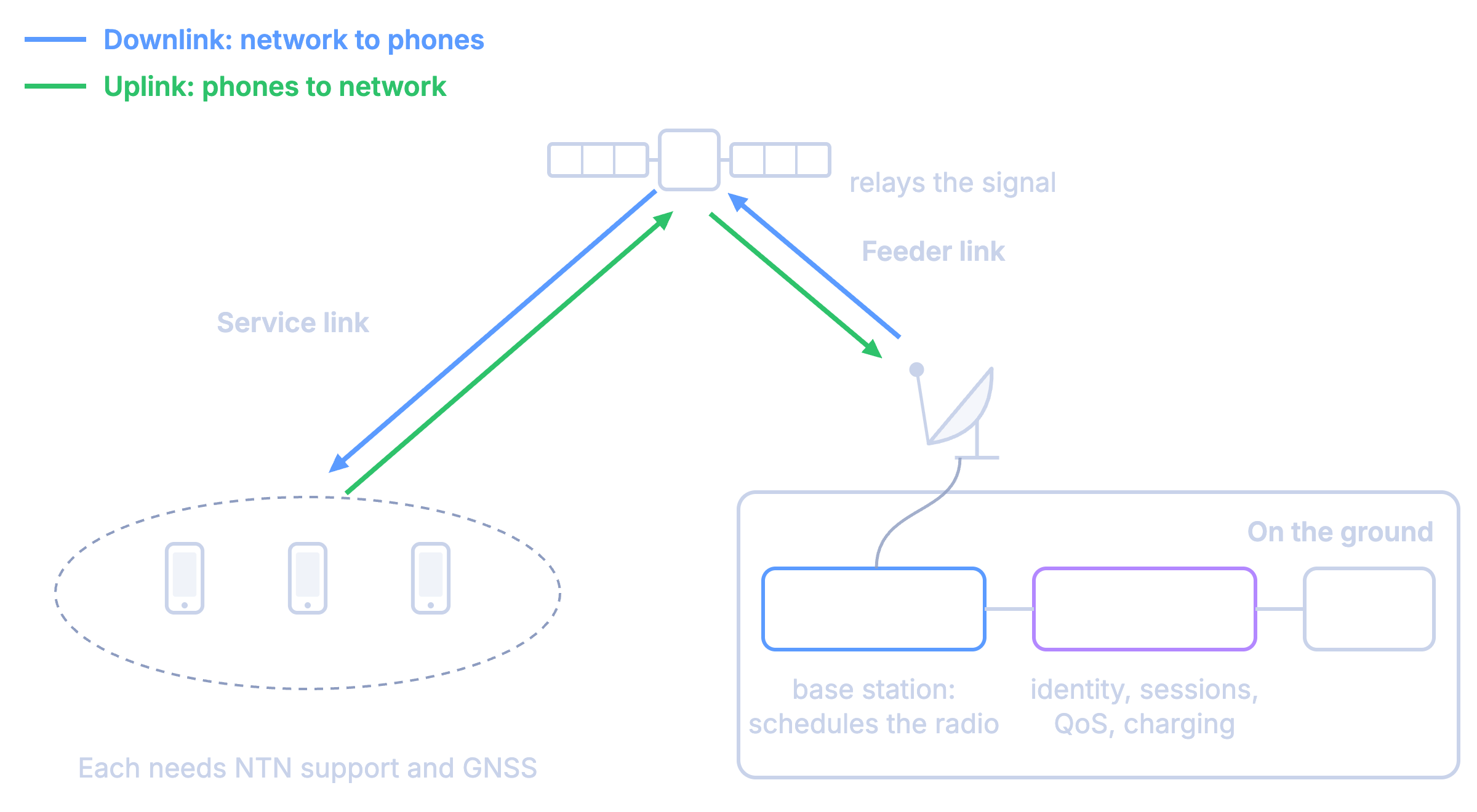
In a mobile network, the phone, or UE (user equipment), connects to a base station called a gNB. The gNB runs the radio: it decides which phone transmits or receives at each moment, and on which frequencies. Behind it, the 5G core handles everything that is not radio, such as identity, sessions, QoS (quality of service) and charging.
In the first NTN release, the satellite is transparent, often called a bent pipe. It relays the signal without decoding it, and the gNB stays on the ground at the gateway. The link between the phone and the satellite is called the service link, and the link between the satellite and the gateway is the feeder link2. To the phone, each satellite beam looks like an ordinary cell. Release 19 adds regenerative satellites, which carry the gNB on board2, and some of the direct-to-phone systems described at the end of this article already put their own base station on the satellite.
Devices and bands
- Two kinds of device. NR-NTN (New Radio, the 5G radio) is for phones and broadband. IoT-NTN carries the low-rate NB-IoT (narrowband Internet of Things) and LTE-M radios, for messaging and sensors. Satellite texting on several Android phones runs on IoT-NTN through Skylo3.
- Bands. Release 17 defined n255 (L-band) and n256 (S-band), between about 1.5 and 2.2 GHz. Release 18 added Ka-band for terminals with dishes or flat panels4.
How the 5G Radio Works
OFDM. 5G uses OFDM (orthogonal frequency-division multiplexing). Instead of sending one fast stream of symbols on one wide carrier, OFDM splits the data into many slower streams and sends them side by side on narrow subcarriers, spaced 15 or 30 kHz apart4. At any moment, each subcarrier carries one modulated symbol, such as a QPSK or 64QAM point, and the transmitter adds all the subcarriers together into a single signal, as Figure 2 shows.
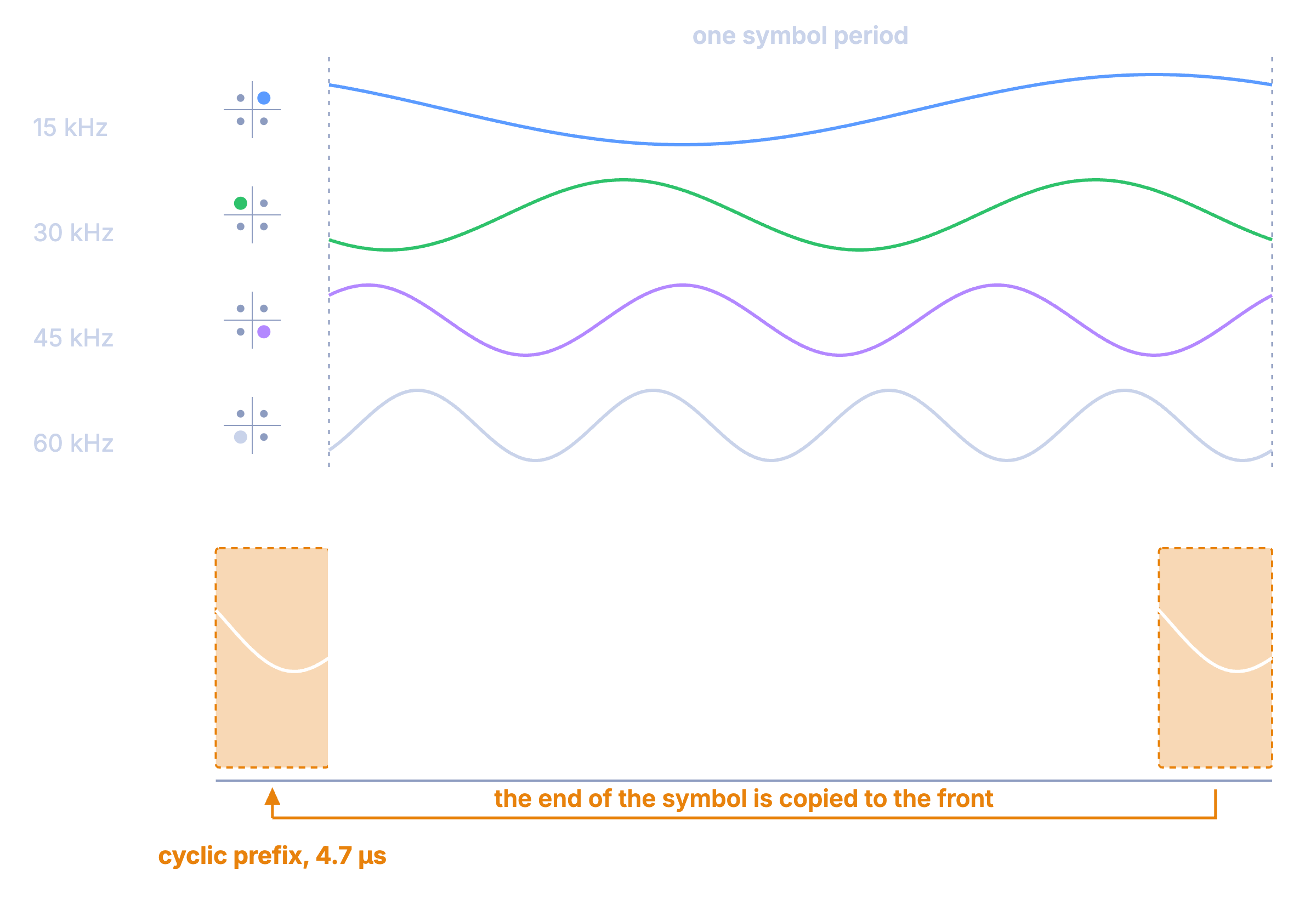
The subcarrier spacing sets how long each symbol lasts. The useful part of a symbol lasts the inverse of the spacing :
In that time, every subcarrier completes a whole number of cycles, which is what makes the subcarriers orthogonal. Their spectra overlap, but at the centre frequency of each subcarrier all the others pass through zero, so the receiver can separate them again with an FFT (fast Fourier transform).
Before each symbol, the transmitter inserts a copy of the symbol's last 4.7 microseconds, called the cyclic prefix5. The prefix absorbs echoes. A signal reflected off buildings arrives a few microseconds after the direct one, so the tail of each symbol spills into the start of the next. That spill lands inside the prefix, which the receiver throws away, and the useful part of the symbol stays clean.
Because the symbol length comes from the spacing, all 5G timing scales with it. At 15 kHz, 14 symbols with their prefixes make a 1 ms slot. At 30 kHz, the symbols, prefixes and slots are all half as long, so a slot takes 0.5 ms. That is why 5G timing values are usually quoted together with a subcarrier spacing.
The grid and the scheduler. Twelve adjacent subcarriers form a resource block, the unit the gNB allocates. In every slot, the gNB decides which resource blocks go to which phone, on both the downlink and the uplink5. It announces these decisions in control information at the start of each slot, the DCI (downlink control information), which tells each phone where to find its data. The data a phone gets in one slot is coded as a single unit, called a transport block, and spread over all the resource blocks it has been given.
The uplink works by request and grant. A phone with data to send asks for capacity and reports how much it has queued. The gNB answers with a grant in a DCI, and the phone transmits in the granted resource blocks a fixed number of slots later. That delay is called K2 and is typically a few slots6.
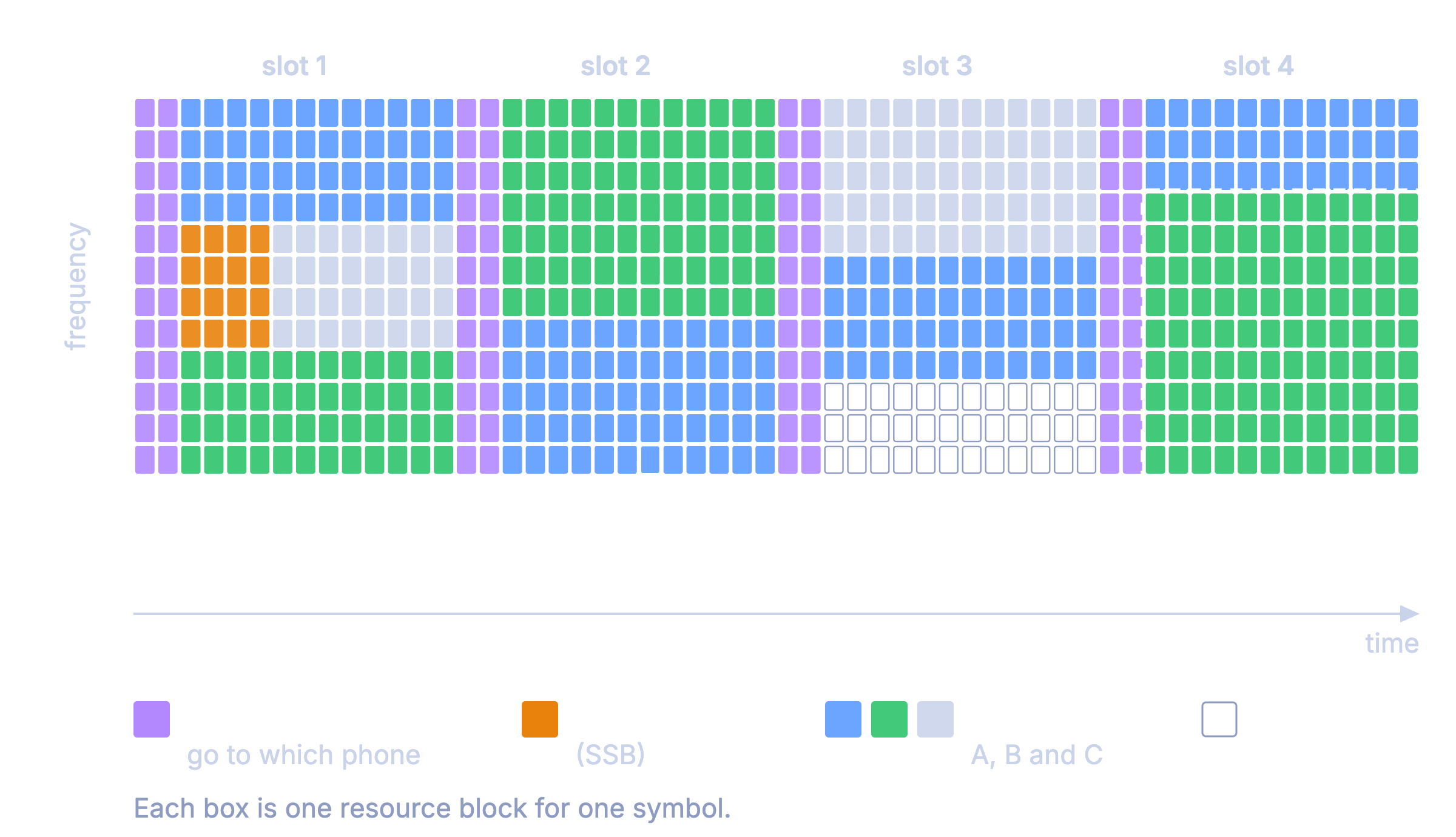
The grid also carries signals that are not user data. The SSB (synchronization signal block) repeats at regular intervals so that phones can find the cell and lock to its timing, and reference symbols scattered through the grid let receivers estimate the channel and measure its quality.
Modulation and coding. Phones regularly report a CQI (channel quality indicator), and the gNB uses it to pick an MCS (modulation and coding scheme) for each phone's transport blocks. The target is that about one transport block in ten fails on the first attempt6. DVB-S2X takes the opposite approach and picks its MODCOD so that frames arrive practically error-free, with about one lost packet in ten million7. 5G can afford the higher error rate because it repairs failures within milliseconds, so a faster MCS with occasional retransmissions carries more data than a cautious one. This only works while acknowledgements come back quickly. Through a satellite, each acknowledgement takes a full round trip: up to about 26 ms through a LEO (low Earth orbit) satellite and 541 ms through a GEO (geostationary) satellite.
Signalling messages
| Message | What it says | How often |
|---|---|---|
| MIB (master information block) | Where to find SIB1 | Every 80 ms |
| SIB1 (system information block 1) | How to access the cell; where the other SIBs are | Every 160 ms |
| SIB19 | NTN only: the satellite's orbit, the common delay, timing offsets, validity | Periodically |
| DCI, from the gNB | Which blocks each phone gets, and at what MCS | Every slot |
| UCI (uplink control information), from the phone | HARQ acknowledgements, CQI, scheduling requests | As needed |
| MAC CE (MAC control element) | Timing advance commands, buffer status reports | As needed |
| RRC (radio resource control) | Connection setup and configuration | At setup and on changes |
Link Budget, Amplifier Power and Doppler
Moving the 5G radio from a tower to a satellite changes three physical things: the link to the phone gets much weaker, the transmitter runs on limited solar power, and the satellite's motion shifts the signal in frequency.
Link budget. 3GPP's NTN study assumes these terminals9:
| VSAT (60 cm dish, Ka-band) | Handheld phone | |
|---|---|---|
| Transmit power | 2 W | 0.2 W |
| Antenna gain | 43.2 dBi transmit, 39.7 dBi receive | 0 dBi |
| EIRP (effective isotropic radiated power) | 45.75 dBW | −7 dBW |
| G/T (antenna gain over noise temperature) | 18.5 dB/K | −33.6 dB/K |
A phone's antenna has no gain, because nobody points a phone at a satellite. When transmitting, the phone has a tenth of the dish terminal's power and about 43 dB less antenna gain, so its EIRP is about 53 dB lower. When receiving, its G/T is about 52 dB worse. Both gaps are factors of more than 100,000. The satellite has to make up the difference with a large antenna and small beams. The service also runs in low frequency bands, because an antenna with no gain collects four times more power at 2 GHz than at 4 GHz. Data rates to phones remain low, and current direct-to-phone services are mostly text and SOS.
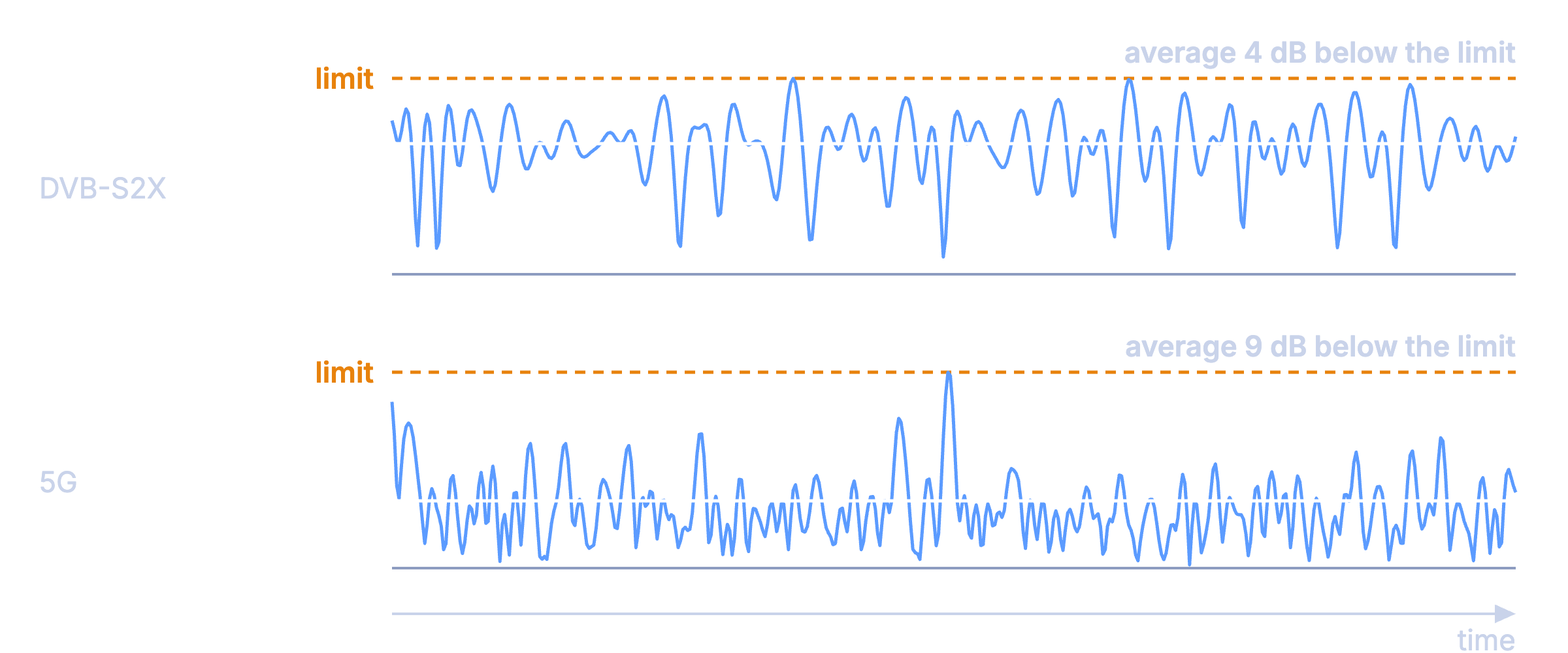
Amplifier power. For the same modulation and coding, OFDM and a single carrier such as DVB-S2X carry about the same bits per hertz: OFDM spends about 7% on the cyclic prefix5, and a single carrier spends 5 to 35% on filter roll-off7. The bigger difference is amplifier efficiency. When many subcarriers are added together, they occasionally line up and produce high peaks. An amplifier distorts anything above its limit, so with OFDM it has to run with its average power well below that limit to leave room for the peaks. A cell tower on grid power can afford this, but a satellite runs on solar power and would rather operate its amplifiers close to the limit. That is why DVB uses a single carrier. NTN uses OFDM anyway, because every phone already has an OFDM modem, and accepts lower average output from the same satellite amplifier. On the uplink, phones can use DFT-s-OFDM, a variant with lower peaks, to get more power out of their small amplifiers5.
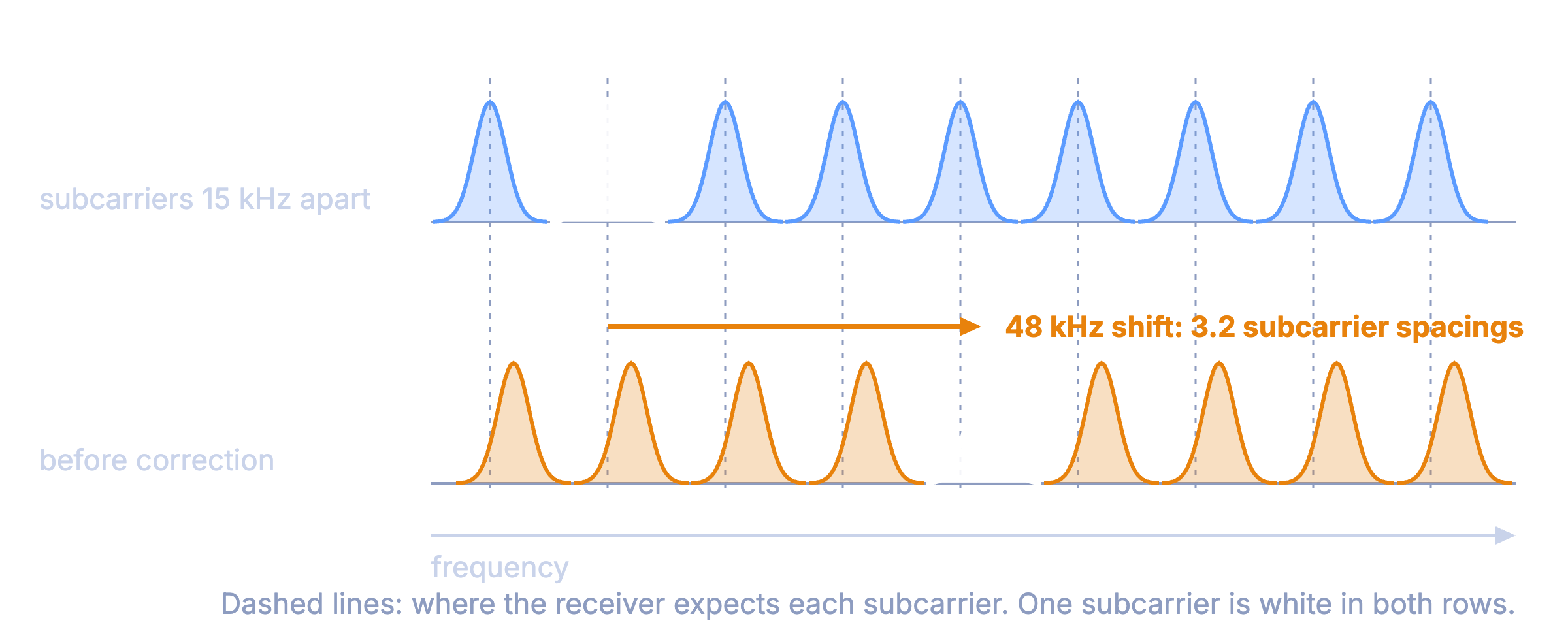
Doppler shift. OFDM relies on each subcarrier sitting exactly on the zeros of its neighbours. If the received signal shifts by a fraction of the subcarrier spacing, that alignment breaks and each subcarrier leaks into the ones next to it. A phone talking to a tower sees almost no shift, but satellites move fast. Under a LEO satellite at 600 km, at 2 GHz, a phone sees a shift of up to about 48 kHz, or 3.2 subcarrier spacings9.
Timing and Synchronization
For the gNB to separate the uplink signals of all its phones, their symbols have to arrive aligned to within the cyclic prefix. Each phone therefore transmits early by its round-trip delay, an offset called the timing advance. A terrestrial gNB measures each phone's delay when it connects and can command a timing advance of up to about 2 ms10. Through a satellite, the round trip is far longer: about 26 ms on LEO at 600 km and 541 ms on GEO11.
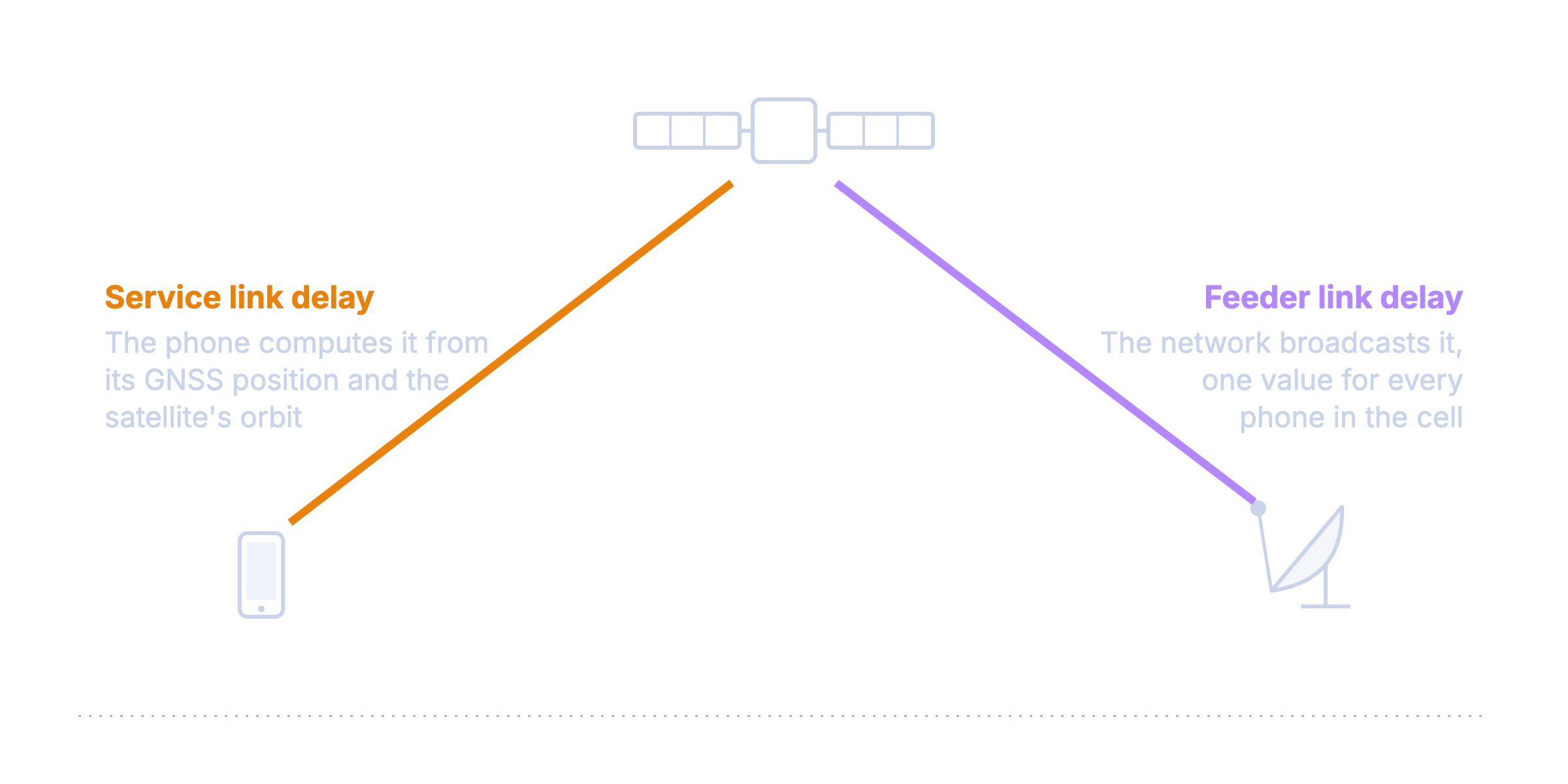
In NTN, the phone works out most of its timing advance itself. It takes its own position from GNSS (global navigation satellite systems such as GPS) and the satellite's orbit from SIB19, a system information message, and computes its delay to the satellite. SIB19 also broadcasts the feeder-link delay as a single value for the whole cell. The phone transmits early by the sum of the two, and the gNB corrects whatever error remains. The phone pre-corrects its frequency for Doppler in the same way2.
As a result, GNSS becomes part of the radio link. Terrestrial LTE and 5G never depended on it, but an NTN phone without a valid position fix may not transmit at all2. Jamming or spoofing GNSS in an area therefore takes out NTN service there too.
The long round trip also affects scheduling. On the ground, a grant tells the phone to transmit K2 slots later. An NTN phone, however, transmits up to a whole round trip early, so by its own clock that slot may already have passed. NTN solves this with an extra offset, Koffset, which SIB19 sets to at least the round trip. It is added to every uplink timing rule: grants, random access and HARQ acknowledgements28.
Joining a Cell
A phone registers with the network when it is switched on, but its radio connection comes and goes. When it has nothing to send, it drops to idle: it keeps listening to the cell for paging but holds no resources or timing advance. Each time it has data to send or is paged, it connects again through random access, or RACH (random access channel), which takes four messages. In NTN, the phone first makes its own timing and frequency corrections, as Figure 7 shows.
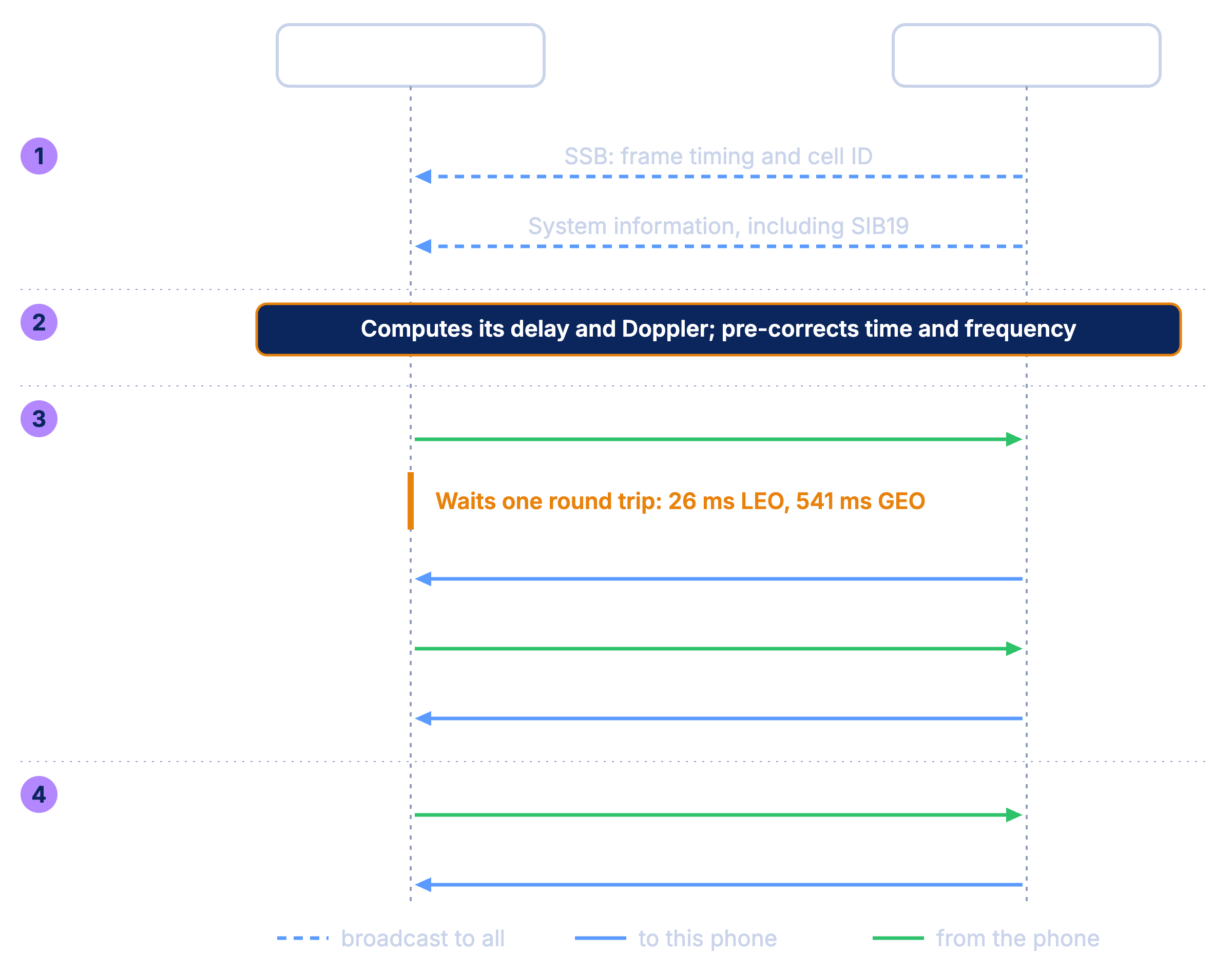
The phone starts by sending a preamble (Msg1). The gNB replies (Msg2) with a timing correction, a first grant and a temporary ID. Msg3 and Msg4 then resolve which phone got in, in case two phones picked the same preamble. A terrestrial phone hears Msg2 within a few milliseconds, whereas an NTN phone only starts listening one round trip later12. Once connected, the phone registers with the network, which brings in the mobile network's usual security: an encrypted identity (SUCI, subscription concealed identifier), mutual authentication with the SIM, and encryption of the radio link13. DVB leaves all of these as options.
Retransmissions Over a Long Round Trip
5G repairs errors at two layers. RLC (radio link control) resends whole packets and takes tens of milliseconds to do so. HARQ (hybrid automatic repeat request) works much faster, within milliseconds. The receiver acknowledges every transport block, and when one fails, the sender transmits additional coded bits, which the receiver combines with what it already received2. Because a failed transmission is rarely wasted, the one-in-ten error target pays off.
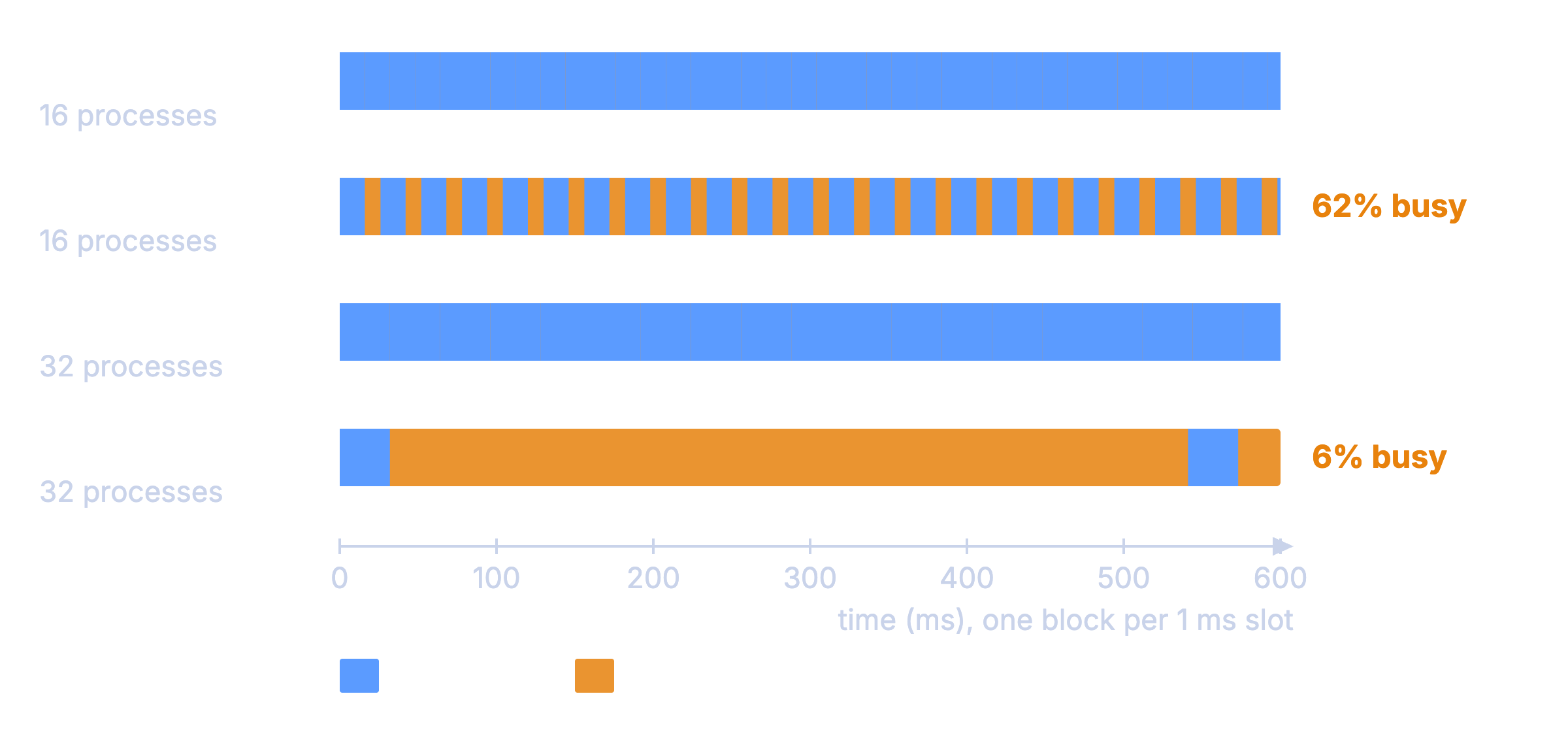
Each transport block in flight occupies a HARQ process until its acknowledgement comes back. Terrestrial 5G allows up to 16 processes per phone, which with 1 ms slots covers 16 ms. That falls short of LEO's 26 ms round trip, so the link would sit idle part of the time. Release 17 raises the limit to 32, which is enough for LEO8. No practical number covers GEO, so there the network can switch HARQ feedback off12. The link then works much like DVB, with a more robust MCS and repairs left to RLC.
Moving Satellites: Cells and Handover
A LEO satellite moves at about 7.5 km/s, and its beams move with it. In earth-moving cells, each beam sweeps across the ground with the satellite, so even a phone that stays in place changes cells often. In quasi-earth-fixed cells, the satellite steers its beam to hold the cell over one area until the next satellite takes over2.
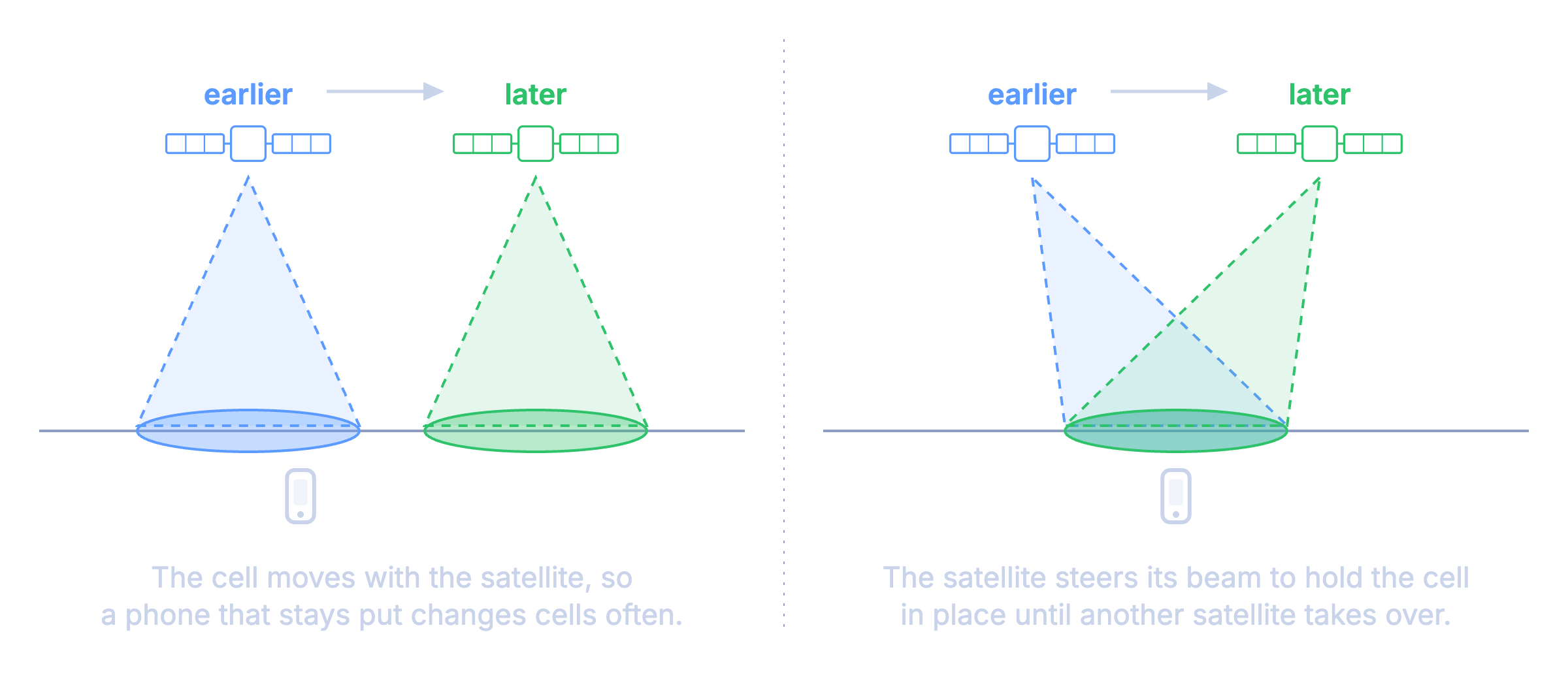
On the ground, a phone hands over when a neighbouring cell becomes stronger. Under a satellite, signal strength barely changes across a beam, so that trigger works poorly. NTN adds conditional handover, triggered either by the phone's distance from the cell centre or by the time at which the satellite will stop serving the cell. Both are known in advance from orbit data2. Release 18 also lets a cell keep its ID when it moves to the next satellite, so phones only need to resynchronize instead of handing over2.
Direct-to-Phone Operators
Satellite service for phones is being built in three ways, which differ mainly in who corrects for the satellite's delay and Doppler shift.
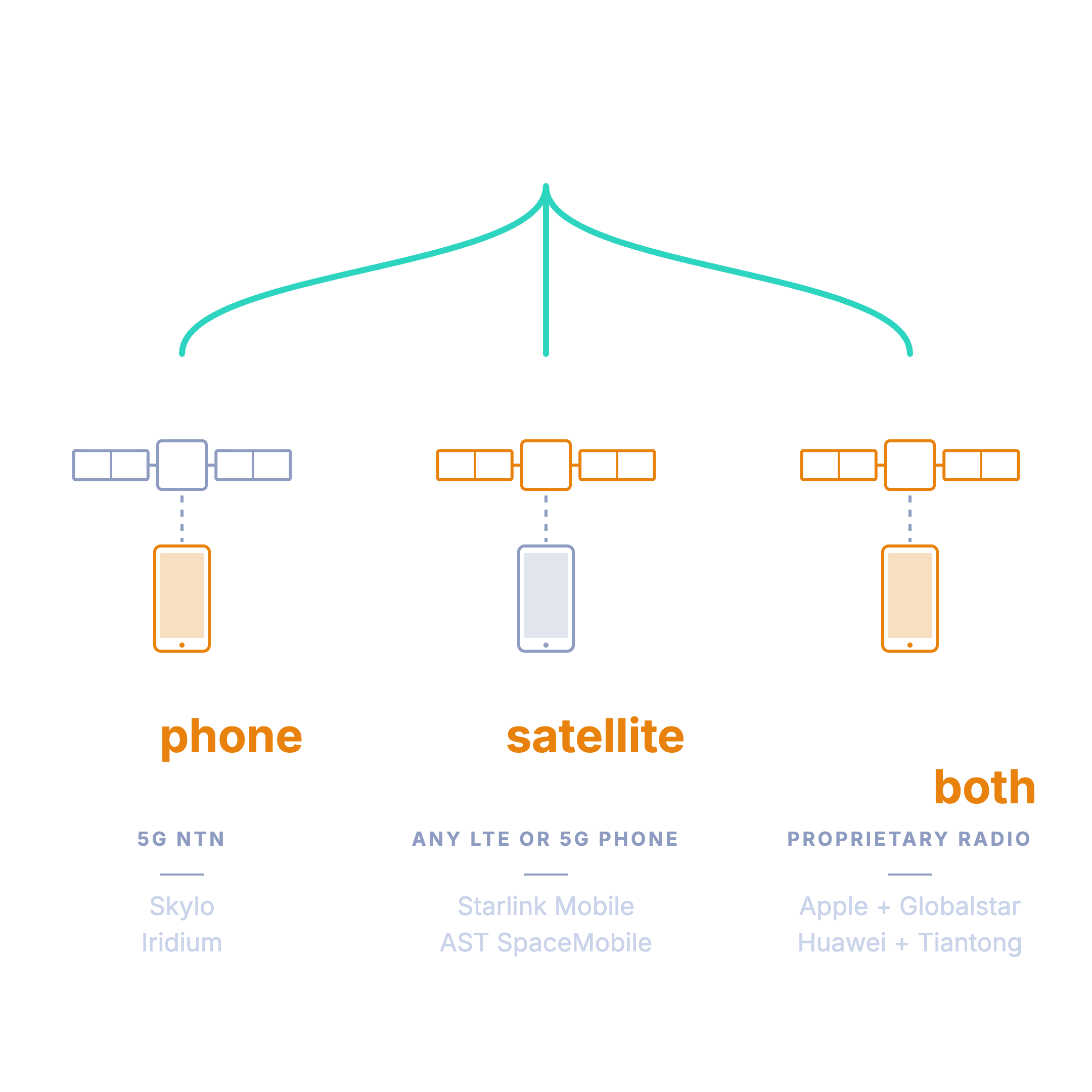
3GPP NTN: the phone corrects. This approach needs a phone with an NTN modem, as in recent Pixel and Galaxy models14, which makes the corrections described above. The services running so far use IoT-NTN for texting, SOS and sensors. No 5G broadband service for phones is running yet.
Ordinary phones: the satellite corrects. Starlink's satellites carry an LTE base station and use spectrum from partner mobile operators, so ordinary phones can connect without changes15. Our post on satellite spectrum covers the spectrum side. Because an unmodified phone cannot correct for the satellite, the satellite shifts the timing and frequency of each beam so that, to phones near the beam centre, it looks like a tower. Starlink has not published exactly how it does this. Phones elsewhere in the beam still see residual errors, and these have to stay within what a phone tolerates, which calls for small beams. AST SpaceMobile serves ordinary phones in the same way, using very large antennas of about 223 m² on its second-generation satellites16.
Proprietary systems. Apple's iPhone satellite features run on Globalstar using Apple's own radio design, and China Telecom's Tiantong serves Huawei and other Chinese phones through GEO satellites.
The two approaches that work with standard phone radios differ in what they ask of the phone, who handles the satellite's delay and Doppler, and which spectrum they use:
| 3GPP NTN | Ordinary phones (Starlink, AST, Elveo) | |
|---|---|---|
| Phone | NTN modem and GNSS required | Any LTE or 5G phone |
| Who corrects delay and Doppler | The phone | The satellite, per beam |
| Spectrum | Satellite bands (L, S, Ka) | Partner operators' mobile bands |
| In service today | Mostly IoT: texting, SOS, sensors | Texting and some data |
Operators and their status
The main direct-to-phone systems, in service and planned, with their status as of November 2026:
| Operator | Approach | Satellites | Status |
|---|---|---|---|
| Skylo | 3GPP IoT-NTN | Partners' GEO | Commercial: texting, SOS3 |
| Iridium NTN Direct | 3GPP IoT-NTN | 66 LEO | Commercial for IoT since November 202617 |
| Starlink Mobile | LTE, base station on board | About 650 LEO18 | Commercial: texting since July 2025, data for some apps1920 |
| AST SpaceMobile | Unmodified phones, operators' bands | 12 LEO | US service expected end of 202621 |
| Elveo Mobile (Lynk and Omnispace) | Base station on board | 9 LEO, 320 planned22 | Pre-commercial23 |
| Apple and Globalstar | Proprietary | Globalstar LEO | Commercial: SOS, messages; Amazon is buying Globalstar24 |
| China Telecom Tiantong | National system | 3 GEO | Commercial in China25 |
| Amazon Leo, Equatys, MDA SpaceRAN | Planned | Thousands filed262728 | Planned |
Standardizing the Satellite Waveform
At the waveform level, 5G NTN changes little. The OFDM signal, the resource grid and the coding are the ones a phone already uses on the ground. What changes is who does the work: the phone computes its own timing advance and pre-corrects Doppler, and the network stretches its scheduling and retransmission timing to cover a round trip of up to 541 ms. The price is paid in the link budget. A phone's link is about 52 dB weaker than a small dish's, so rates stay low and the satellite needs large antennas and small beams.
As with VSAT return links, direct-to-phone waveforms also started out proprietary, with vendors free to design their own: for example, Apple with Globalstar and Huawei with Tiantong use proprietary waveforms. However, the large user base of standardized phones has compelled the industry to serve unmodified phones, as Starlink and AST SpaceMobile do. At the same time, 3GPP standards are evolving the phone to shoulder more of the responsibility of communicating with a far-away, moving satellite. To make this task possible for phones, 5G NTN expects them to have GNSS capabilities.
Current deployments are limited to narrowband applications such as texting and SOS, where losing GNSS matters most, and GNSS jamming is now common near conflict zones. Release 20, which is still being finalized, is working on ways for phones to keep working without it29.
Phones are primarily designed to work in urban multipath environments, and so their radio is built around OFDM, a modulation scheme that is not as easy on the satellite's amplifier, which would prefer a single-carrier scheme such as continuous phase modulation (CPM).
While we see this standardization of satellite waveforms as a net positive for the satellite communication industry, the fundamental differences in the nature of the constraints between terrestrial and satellite links make for interesting trade-offs.
Sources
-
3GPP TS 38.300: NR overall description, Release 19. NTN architecture, transparent and regenerative payloads, GNSS requirement, timing and Doppler pre-compensation, cell types, conditional handover and satellite switch (clause 16.14). ↩ ↩2 ↩3 ↩4 ↩5 ↩6 ↩7 ↩8 ↩9
-
Skylo: NTN connectivity: Release 17 NB-IoT NTN. ↩ ↩2
-
3GPP TS 38.101-5: NTN user equipment radio requirements. Bands and subcarrier spacings. ↩ ↩2
-
3GPP TS 38.211: NR physical channels and modulation. Numerology, slots, resource blocks, cyclic prefix, the 1,008 cell IDs and the NTN timing advance (clauses 4 and 7.4). ↩ ↩2 ↩3 ↩4 ↩5
-
3GPP TS 38.214: NR physical layer procedures for data. MCS tables and the CQI definition with a block error target of 0.1 (clauses 5.1.3 and 5.2.2.1). ↩ ↩2
-
ETSI EN 302 307-1 (DVB-S2): the quasi-error-free target and roll-off factors of 0.20 to 0.35; ETSI EN 302 307-2 (DVB-S2X) adds roll-off factors of 0.05 to 0.15. ↩ ↩2
-
3GPP TS 38.331: NR radio resource control. SIB19 and NTN-Config, including the orbit data, its validity and Koffset; the number of HARQ processes. ↩ ↩2 ↩3
-
3GPP TR 38.811: NR to support NTN, study. Doppler shift for LEO at 600 km (table 5.3.4.3.2-7). ↩ ↩2
-
3GPP TS 38.213: NR physical layer procedures. Timing advance range and Koffset (clause 4.2). ↩
-
3GPP TR 38.821: solutions for NR to support NTN. Round-trip delays by orbit (table 4.2-2). ↩
-
3GPP TS 38.321: NR MAC. HARQ feedback disabling and random-access timing in NTN. ↩ ↩2
-
3GPP TS 33.501: 5G security architecture. SUCI (clause 6.12) and authentication. ↩
-
Samsung: satellite communication support on Galaxy smartphones in the US. ↩
-
Starlink: Direct to Cell, archived February 2025: eNodeB on board, works with existing LTE phones. ↩
-
AST SpaceMobile: next-generation BlueBird: array sizes. ↩
-
SatNews: Iridium activates commercial service on its NB-IoT direct-to-device network, November 2026. ↩
-
Broadband Breakfast: T-Mobile and Starlink satellite service to launch July 23, 2025. ↩
-
AST SpaceMobile: Q3 2026 business update, November 2026: satellites in orbit and service plans. ↩
-
Light Reading: Lynk and Omnispace merger creates Elveo Mobile: satellites in orbit. ↩
-
Lynk and Omnispace launch Elveo Mobile, August 2026. ↩
-
Via Satellite: Amazon enters D2D market with Globalstar acquisition, April 2026. ↩
-
Light Reading: China Telecom picks Hong Kong for direct-to-phone satellite service. ↩
-
SatNews: Space42 and Viasat formally establish Equatys, September 2026. ↩
-
SpaceQ: MDA Space makes a direct-to-device play with SpaceRAN. ↩
-
3GPP TR 38.742: Study on GNSS resilient NR-NTN operation, Release 20 draft, February 2026. ↩