
Satellite Waveforms: VSAT
How DVB-based VSAT networks work: forward frames, return bursts, timing, logon, security, vendor terms, and what changes when terminals or satellites move.
A waveform is the set of rules for putting bits on the air: how data is framed, coded and modulated, who may transmit when, and how terminals stay in step. Most VSAT (very small aperture terminal) networks run on DVB (Digital Video Broadcasting) standards, and hub vendors build their own variants on the same ideas.
This post explains how those rules fit together in a DVB network. Traffic goes out to the terminals on one shared stream and comes back in short bursts on a schedule the hub sets. The rest follows from that: how terminals keep time, how they are admitted, how vendors name the same parts, and what changes when the terminal or the satellite moves.
The Network
A satellite covers its service area with beams, and the spectrum in each beam is divided into carriers. This post follows one forward carrier in one beam, together with the return carriers that answer it. Vendors usually call that set a "network", and a satellite operator runs many of them side by side, across beams, gateways and satellites.
The spectrum is split into carriers because each end of the link can only handle so much. A gateway has a large dish and amplifier, so its forward carrier can be wide: a conventional transponder is 36, 54 or 72 MHz1, and DVB-S2X's wideband mode targets carriers of 200 to 500 MHz on high-throughput satellites2. A terminal's small amplifier can only put enough power into a narrow signal, so return carriers are small, typically up to about 2 million symbols per second, roughly 2 MHz3. Many of them share the beam's return band.
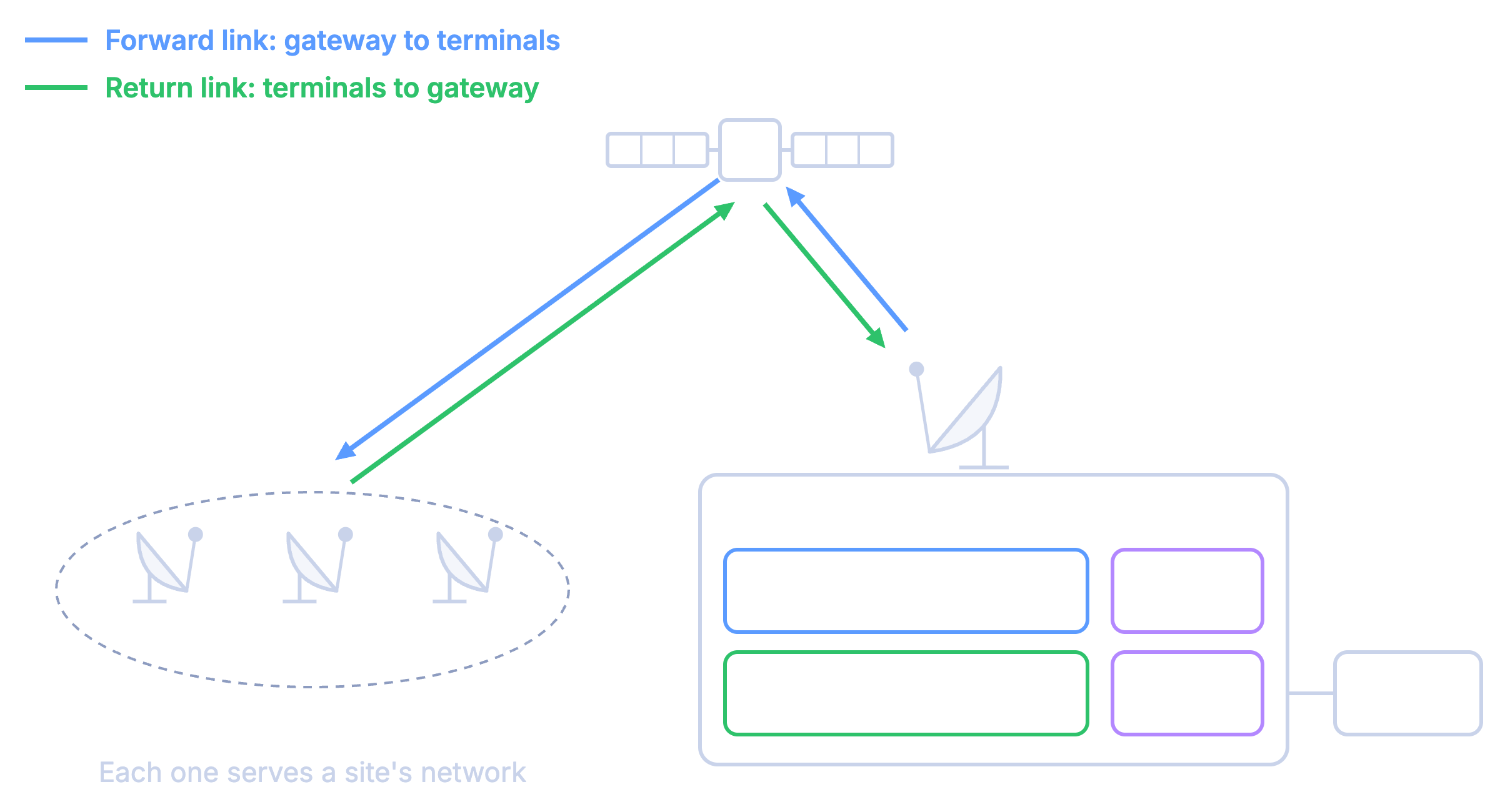
The gateway transmits one forward carrier per beam and receives the bursts of every terminal in it. Its NCC (Network Control Centre) runs the waveform in real time: it keeps the network clock, decides which terminal transmits when, and corrects each terminal's timing. The NMC (Network Management Centre) handles configuration and monitoring.
Network topologies and satellite payloads
- Star or mesh. In a star network, all traffic goes through the gateway; most broadband VSAT networks work this way. In a mesh network, terminals send to each other directly over the satellite, but the NCC still controls who transmits when.
- Transparent payload. A transparent satellite (a "bent pipe") filters, shifts and amplifies the signal without decoding it. Eutelsat OneWeb's first-generation satellites work this way4. A digital transparent processor goes further: it digitizes the signal, can connect any beam to any other, and can change each beam's bandwidth and power from the ground. SES-17 carries one, with nearly 200 beams5. Because nothing is decoded, noise and interference picked up on the uplink still pass through to the downlink, so the uplink and downlink budgets stay coupled.
- Regenerative payload. A regenerative satellite demodulates and decodes the signal on board. That separates the uplink and downlink budgets and lets the satellite switch packets between beams or onto links to other satellites. Starlink routes traffic between satellites over laser links instead of through ground gateways4.
- Where the NCC sits. Usually at the gateway. With a regenerative satellite it can run on board, which halves the time a capacity request takes.
Forward Link: Broadcast to All Terminals on a Carrier
The forward link, from the gateway to terminals, uses DVB-S2X6. The gateway is the only sender on a carrier, so it transmits one continuous stream. Every terminal assigned to that carrier receives all of it and keeps only what is labelled for it. Which carrier a terminal listens to is set in the hub's configuration; mobile terminals switch beams automatically.
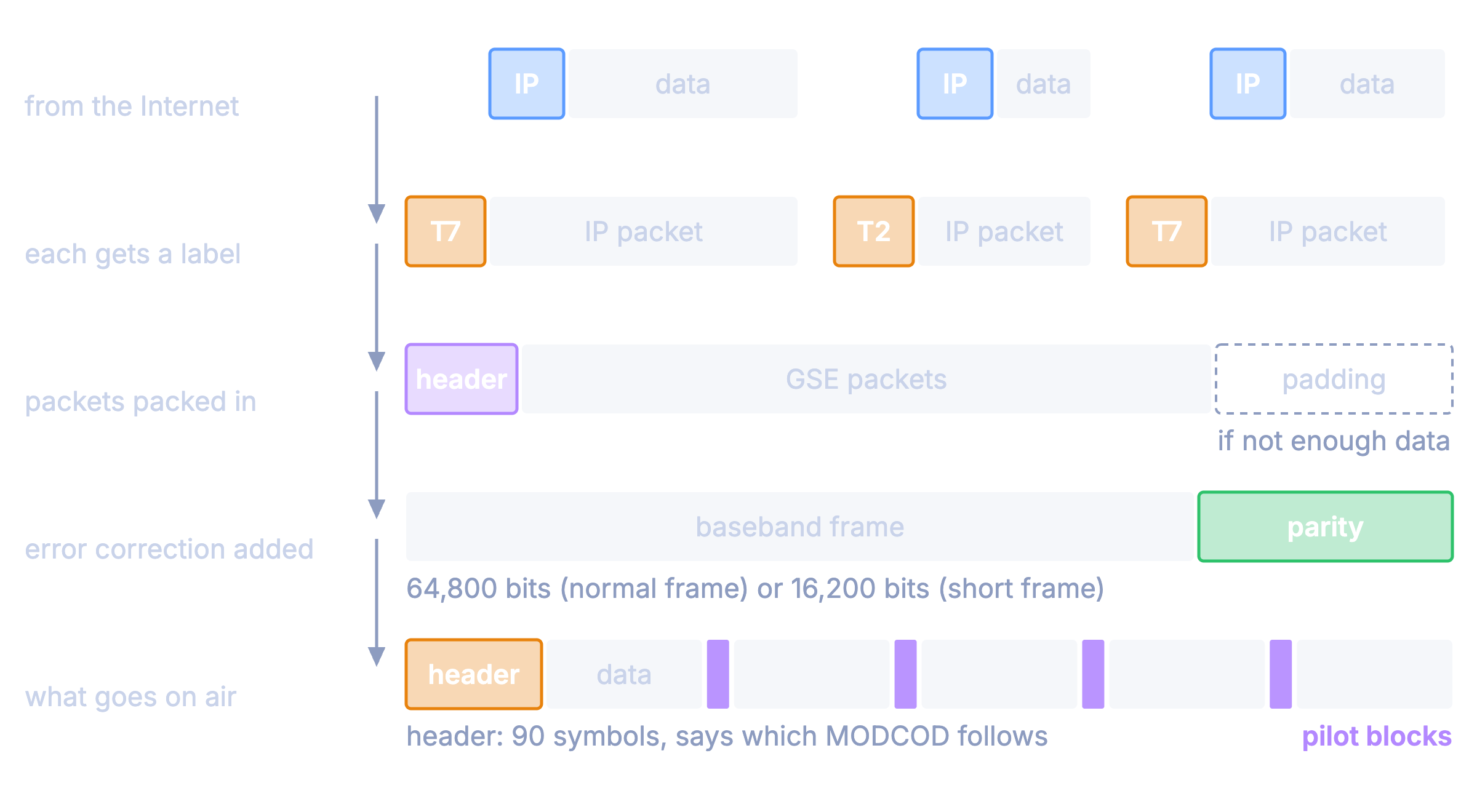
GSE (Generic Stream Encapsulation) puts a label naming the destination terminal in front of each IP (Internet Protocol) packet. The labelled packets fill a baseband frame, padded if there is not enough data. FEC (forward error correction) adds parity bits so the receiver can repair errors. Finally, a header tells the receiver which MODCOD (modulation and code rate) follows, and pilot blocks of known symbols help it stay locked to the signal.
Each frame can use a different MODCOD. Terminals report how well they receive, and the gateway codes each frame for the terminal it is addressed to: a robust MODCOD for a terminal under rain, a faster one for a terminal in clear sky. This keeps a terminal online through rain fade, but at a lower data rate, and its traffic takes up more of the carrier while the fade lasts.
The same stream carries the network's own signalling. The network clock, the tables that describe the return-link grid, the burst time plan and timing corrections all travel as GSE packets too7. Messages meant for every terminal carry no label, and messages for one terminal carry its hardware ID. All of them go out on the most robust MODCOD in use, so every terminal can read them.
Return Link: Scheduled Bursts from Each Terminal
The return link, from terminals to the gateway, uses DVB-RCS27. It has hundreds or thousands of senders. The beam's return band is split into narrow carriers, and each carrier is split in time into slots. A terminal can use a slot on one carrier and its next slot on another: MF-TDMA (multi-frequency time-division multiple access). The NCC groups slots into frames and frames into a superframe, the unit it schedules. A terminal transmits a short burst only in a slot the NCC assigned to it. Two bursts in the same slot destroy each other.
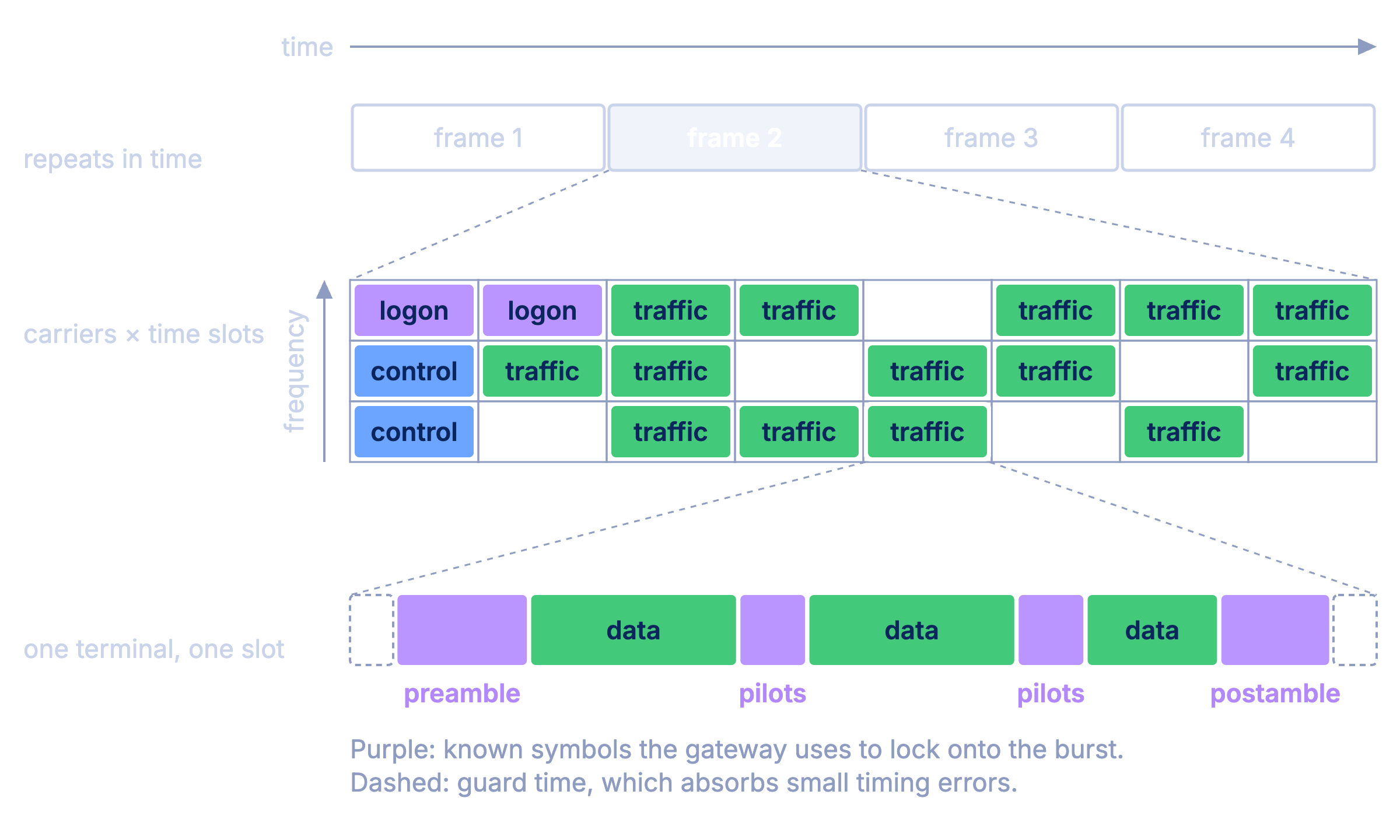
The NCC broadcasts a new slot plan, the TBTP2 (Terminal Burst Time Plan), for every superframe. Each frame sets aside slots for logon (shared, used to join), control (per terminal, used to stay synchronized) and traffic. Known symbols at the start, middle and end of each burst let the gateway find its exact timing, frequency and phase.
Terminals ask for capacity in their control bursts, either as a rate or as an amount of queued data, and the NCC grants slots in a later burst time plan. The request has to reach the gateway and the plan has to come back, so on-demand capacity arrives about one round trip after the traffic: roughly half a second over a geostationary satellite3.
Bursts are small, so one IP packet usually spans several of them. RLE (Return Link Encapsulation) cuts it into fragments, and the gateway reassembles them. The NCC can change the MODCOD, symbol rate and burst length of a terminal's slots from one superframe to the next, so the return link adapts to each terminal's signal too. DVB-RCS2 defines two kinds of burst for this: linear modulation, the more spectrally efficient and common choice, and CPM (continuous phase modulation), whose constant amplitude lets a low-cost terminal's amplifier run at full power7.
How terminals learn the grid
The NCC describes the grid in broadcast tables, sent in the forward-link signalling described above.
| Table | What it says | How often it changes |
|---|---|---|
| SCT (Superframe Composition Table) | When and where each superframe and its frames sit | Rarely |
| FCT2 (Frame Composition Table) | How each frame type divides into slots | Rarely |
| BCT (Broadcast Configuration Table) | Burst formats: modulation, coding, length and content (logon, control, traffic) | Rarely |
| TBTP2 (Terminal Burst Time Plan) | Which terminal owns which slot in the next superframe | Every superframe |
Beam hopping
Carriers share a beam's spectrum, and slots share each carrier in time. Beam hopping shares the satellite itself across beams in time. Instead of giving each beam a fixed slice of power and bandwidth, one amplifier serves a group of beams and lights them one at a time, following a time plan. Busy beams stay lit longer3, and a lit beam gets the full carrier and power. Unlike steering or beamforming, the beams stay where they are; only which one is lit changes.
On the forward link, terminals receive only while their beam is lit, so DVB-S2X has an optional framing that groups frames behind a known preamble, letting them lock on again at the start of each dwell6, and the time plan reaches them with the rest of the forward-link signalling7. On the return link nothing changes for the terminal: the NCC assigns its slots to times when its beam is lit3.
Timing and Synchronization
Terminals in one beam sit at different distances from the satellite, so their signals take different times to reach it. For bursts to land in their own slots, every terminal must share one clock and transmit early by its own travel time.
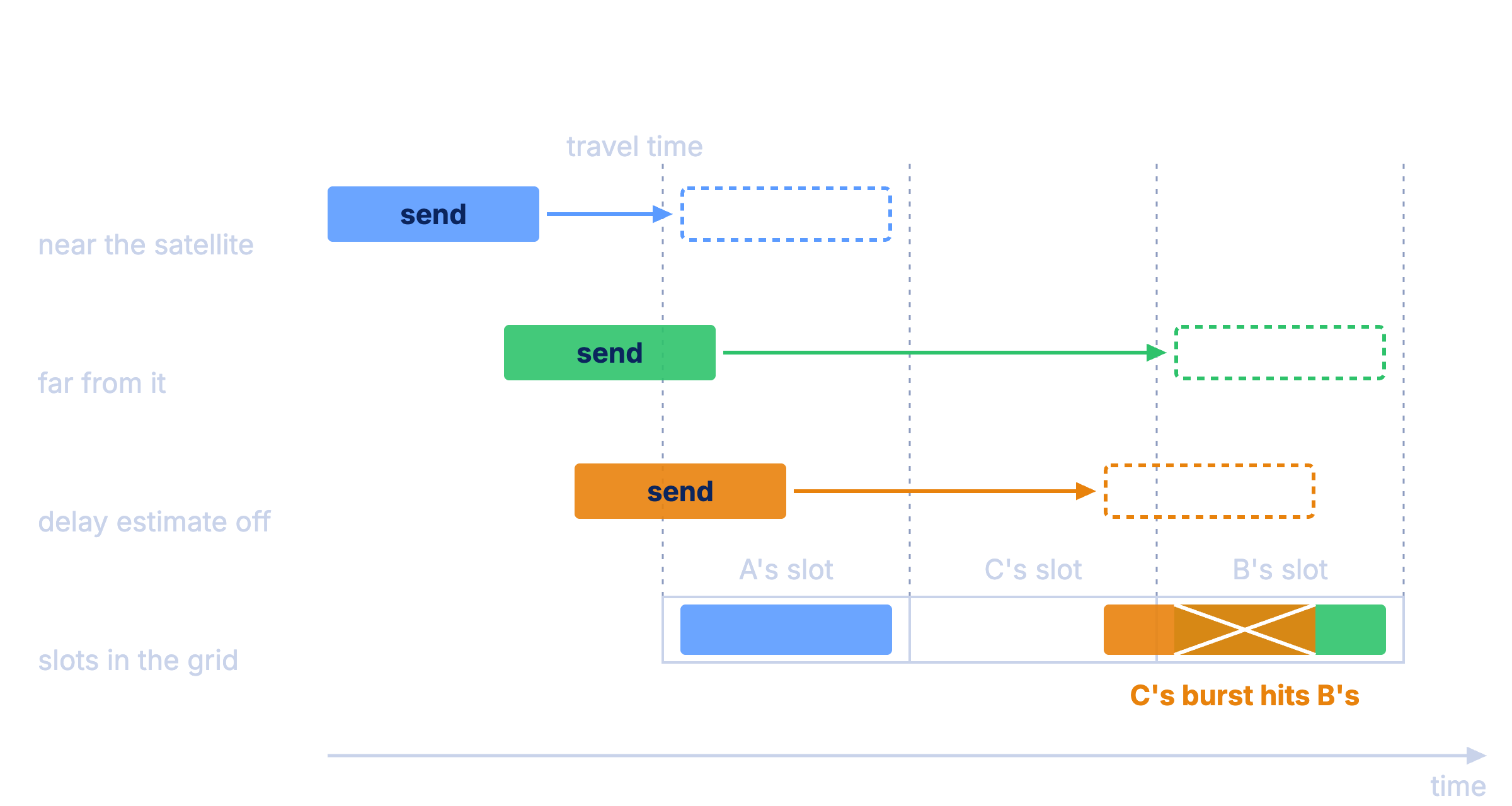
The gateway runs a 27 MHz counter, the NCR (Network Clock Reference), and inserts its current value into the forward link several times a second7. Each terminal steers its own oscillator to match, so all terminals count the same ticks and agree on when each slot starts. Each terminal then estimates its travel time from its own location and the satellite's position, which the NCC broadcasts. To keep that estimate accurate, each terminal sends a control burst in its own control slot at regular intervals. The gateway measures the burst's timing, frequency and power, and the NCC sends corrections back on the forward link, either broadcast to a group of terminals or addressed to one7.
The gap between bursts is only a few microseconds. A first estimate from location is not that accurate, so logon slots get a wider gap, and control bursts tighten the timing before a terminal may send traffic.
Provisioning, Identity and Logon
Provisioning is outside the waveform specification. Before a terminal can join, the operator adds it to the hub's management system with its hardware ID, the network it belongs to and its service plan. DVB-RCS2 only lets the NCC accept a logon, refuse it as unauthorized, or turn it away for lack of capacity7. iDirect's hub, for example, only invites terminals that are activated in its management system to join8. At installation, the NCC can also make a new terminal prove its antenna is pointed correctly: the terminal transmits a test signal, and the NCC reports what it measures so the installer can fine-tune pointing and polarization7.
Every terminal has a 48-bit hardware ID, built like an Ethernet MAC address and stored in the modem7. Logon slots are shared, so the logon burst has to carry that ID. If the NCC admits the terminal, it hands back short IDs, and from then on the burst time plan refers to the terminal only by those.
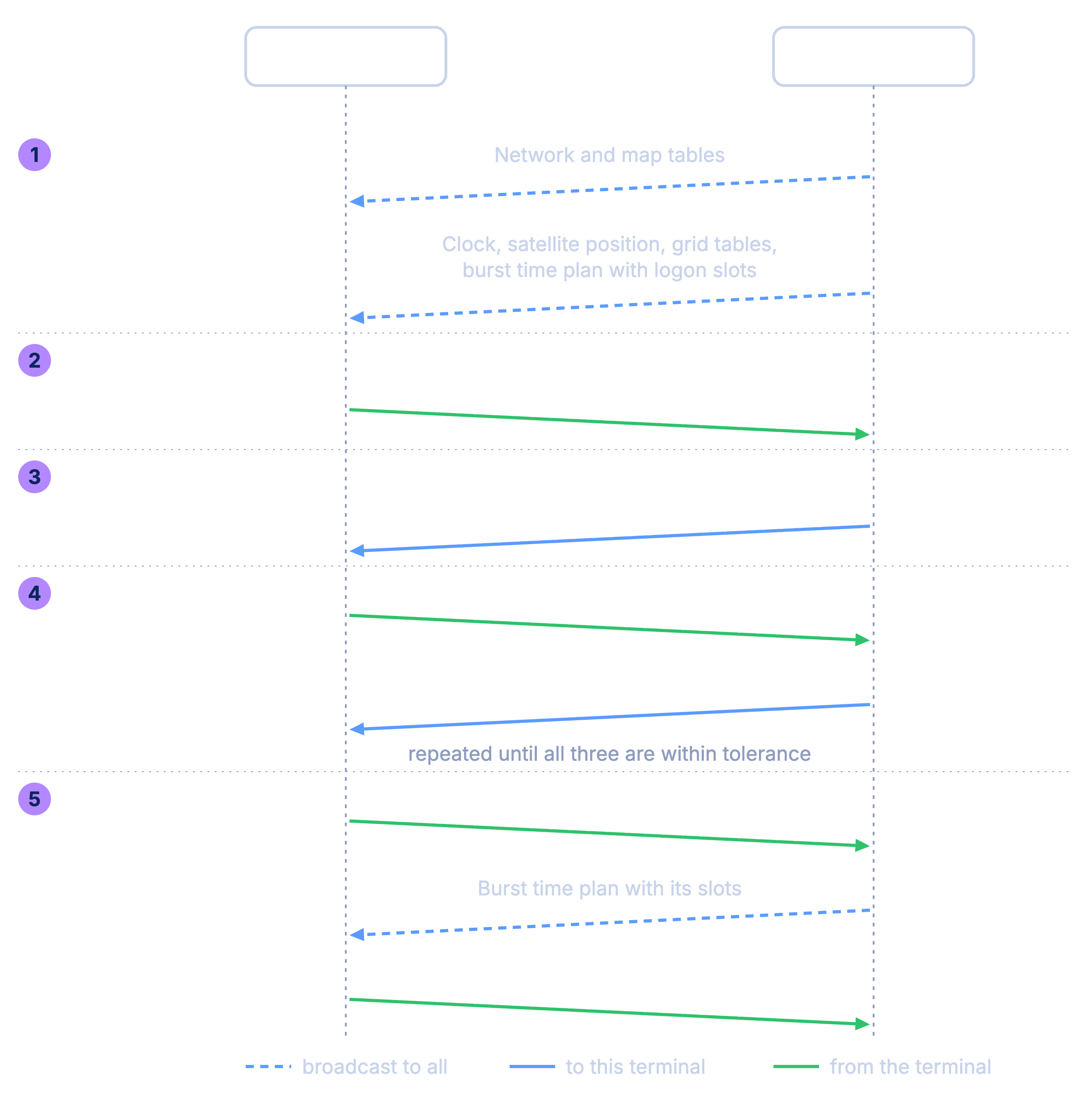
After the logon burst, the terminal exchanges control bursts and corrections until timing, frequency and power are within tolerance, and only then requests capacity for traffic.
Traffic bursts in a terminal's own slots carry no sender ID. The gateway knows the source only because the NCC assigned that slot to that terminal7.
Security
DVB-S2X and DVB-RCS2 carry traffic but do not protect it by default. Any receiver tuned to a forward carrier can read the packets it can decode: in 2025, researchers with an $800 consumer dish found unencrypted traffic, including mobile backhaul and corporate email, on about half the satellite links they scanned9. The signalling tables are sent in the clear too, because a terminal has to read them before it has any keys, so a listener can see how much capacity each terminal gets. On the return link, a terminal is identified only by a hardware ID sent in the clear and by the slots it owns, so a copied ID, or a burst sent in someone else's slot, is credited to that terminal.
Protection is added on top, and all of it is optional10. Authenticated logon has the terminal sign its logon with a password-based signature tied to the slot it uses, so a copied ID or a recorded logon is rejected7. TRANSEC (transmission security), which the standard leaves to vendors, can encrypt every burst and the signalling, hide how busy each terminal is, and authenticate terminals with keys or certificates38. Customers can add their own encryption as well, such as a VPN (virtual private network) or TLS (Transport Layer Security). None of this stops someone transmitting in another terminal's slot: they cannot impersonate the terminal, but they can still jam it3.
Vendor Implementations
Most hub vendors use DVB-S2 or DVB-S2X on the forward link. The return link is where they differ, and every vendor names the same parts differently.
| DVB-RCS2 | iDirect | Newtec Dialog | Hughes | Gilat | Comtech (UHP) | |
|---|---|---|---|---|---|---|
| Forward link | forward link | downstream, outbound | forward link | outroute | outbound | outroute |
| Return link | return link | upstream, inbound | return link | inroute | inbound | inroute |
| Terminal | RCST | remote | terminal, modem | VSAT | VSAT | station |
| One forward carrier and its return carriers (roughly a beam) | network | satellite network ("satnet") | network | |||
| Return carriers sharing one pool | inroute group | return capacity group | inroute group | |||
| Scheduler (the NCC role) | NCC | protocol processor | inroute group manager | |||
| Management system | NMC | iBuilder and iMonitor, Pulse, Intuition NMS | Dialog NMS | NMS | TotalNMS | UHP NMS, ELEVATE NMS |
Blank cells: no public term found. RCST is DVB's name for a terminal (return channel satellite terminal). ST Engineering now owns both iDirect and Newtec.
The biggest practical difference is how terminals share the return link. There are three approaches, and several hubs offer more than one.
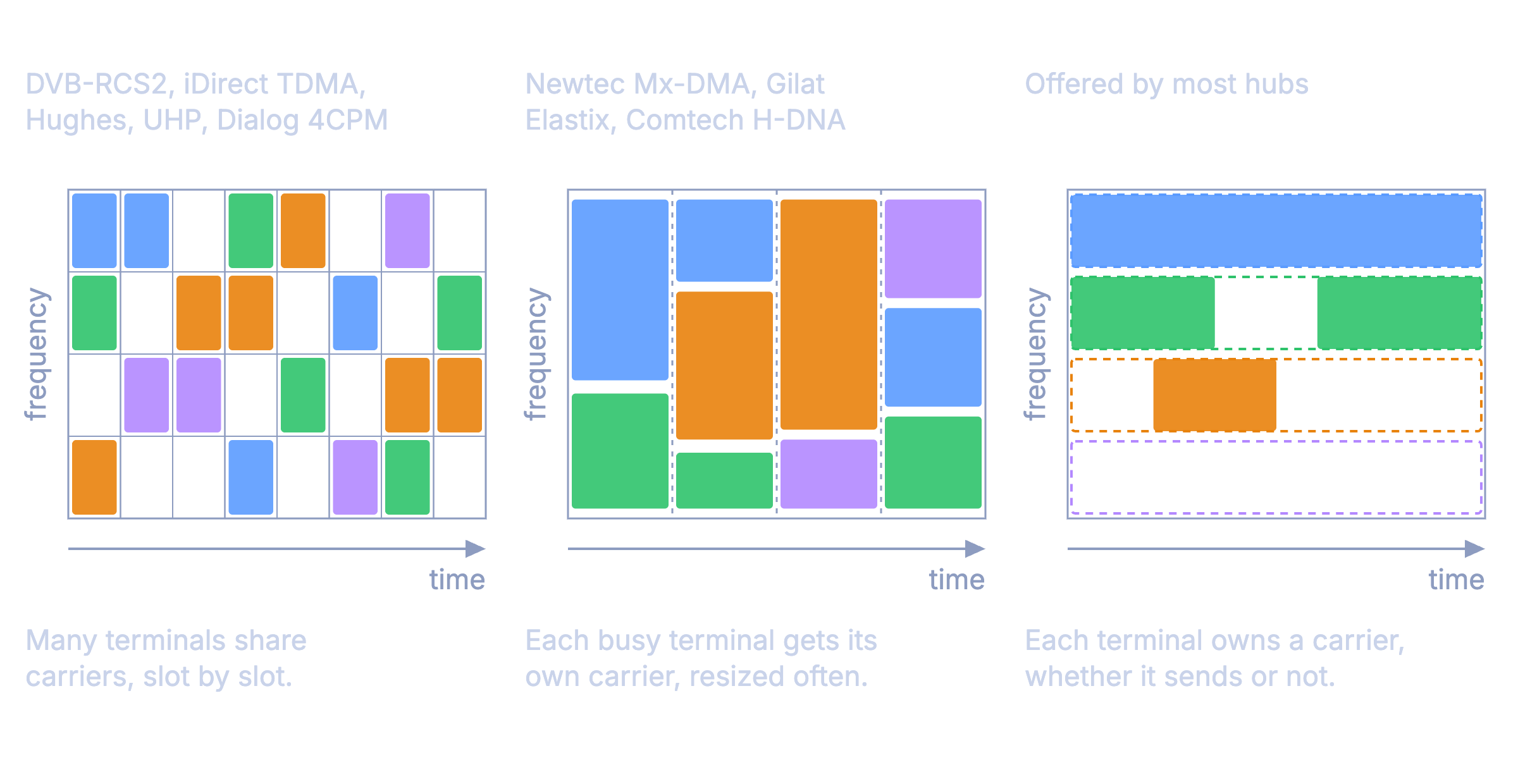
- Shared time slots (TDMA, time-division multiple access) suit many small, bursty sites, at the cost of some overhead per burst.
- Carriers sized on demand, such as Newtec's Mx-DMA, suit sites with heavy traffic that still varies.
- Dedicated carriers, SCPC (single channel per carrier), suit steady, heavy traffic, but the capacity is paid for even when the site is idle.
Moving Terminals and NGSO Satellites
On a geostationary (GEO) satellite with fixed terminals, the geometry barely changes. A terminal synchronizes once at logon, and small corrections keep it in step. Once the terminal or the satellite moves, the signal's frequency shifts (Doppler shift) and its travel time keeps changing. That happens to a terminal on an aircraft or a ship, and to every terminal on a non-geostationary (NGSO) satellite in low or medium Earth orbit (LEO or MEO).
Speed limits how narrow a carrier can be. A gateway demodulator tolerates only a small frequency error relative to a carrier's symbol rate, so the narrower the carrier, the less Doppler shift it can absorb. A fast terminal, such as one on an aircraft, needs a wider return carrier than usual unless it corrects the shift itself3. On LEO the shift is far larger, so every terminal predicts it from its position and the satellite's orbit and pre-corrects its bursts before sending. Waiting for the gateway's corrections does not work, because they are out of date by the time they arrive.
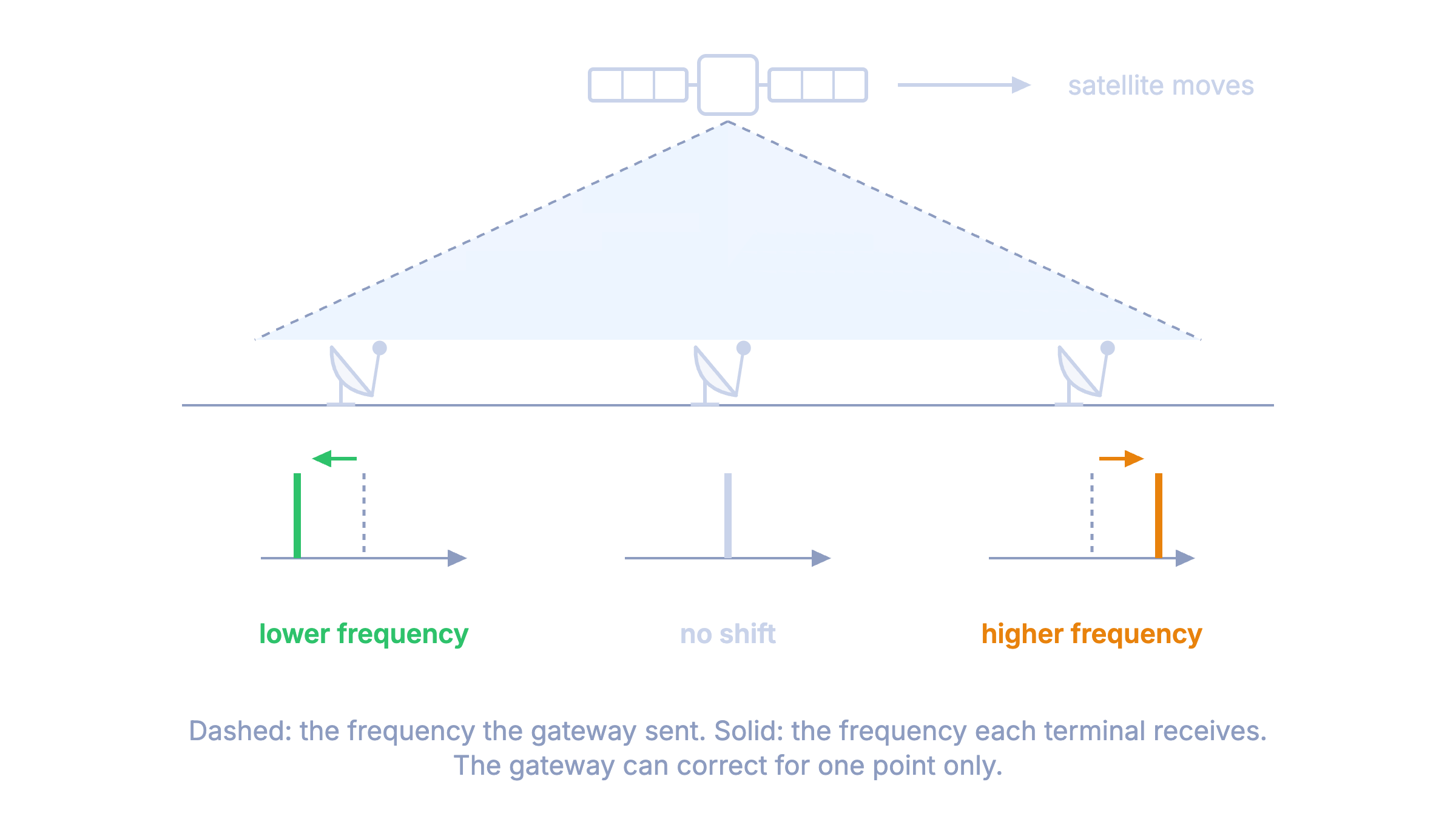
Because the shift differs across a beam, the gateway can correct its forward carrier for only one point, usually the beam centre, so each terminal tracks the rest itself, and pre-corrects its return bursts so they all arrive on the same frequency grid and in their own slots.
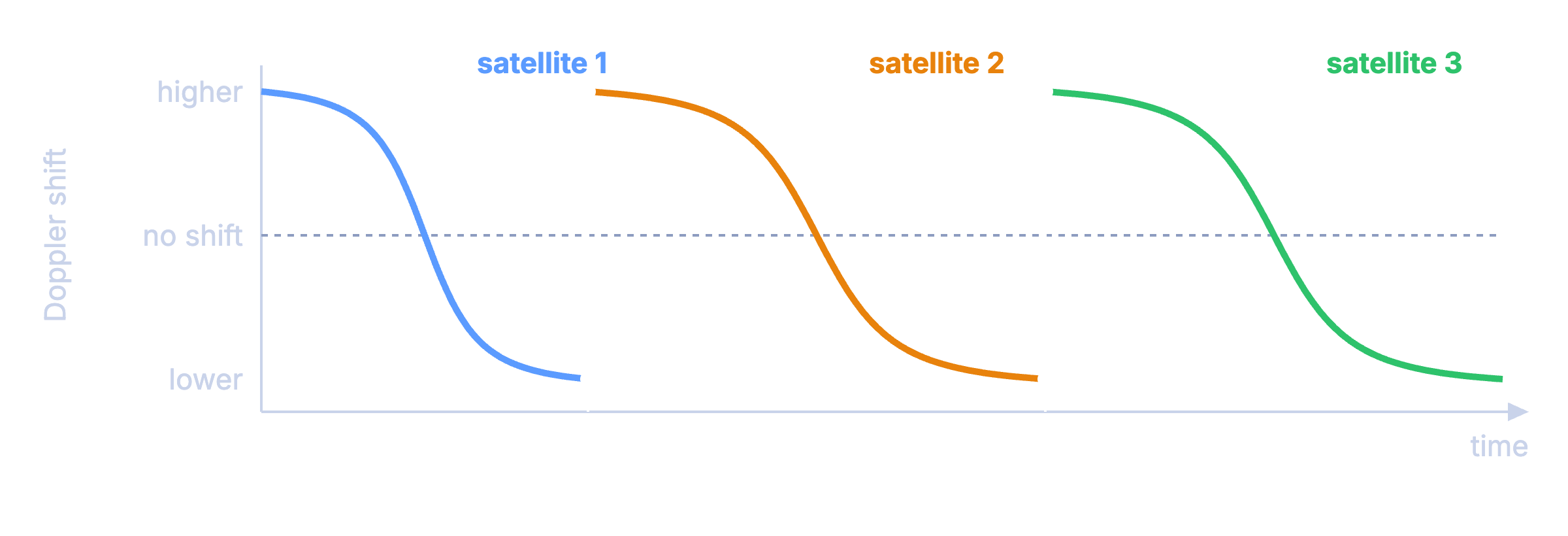
On NGSO, the serving satellite also changes. A LEO satellite is in view for minutes, a MEO one for hours. At handover, the terminal swaps a satellite moving away for one moving towards it, so the Doppler shift flips, the delay jumps and synchronization starts over. DVB-RCS2 originally handled this as log off and log on again, with a gap in traffic; the 2026 revision adds make-before-break handover.
Handovers in practice
- Handovers are frequent and scheduled. SES quotes about one satellite handover an hour on MEO and about one every 10 minutes on LEO11. They are planned from orbit data, not triggered by a failing signal.
- Two antennas, or one that steers electronically. MEO terminals typically use two dishes, so one can acquire the rising satellite while the other still tracks the setting one.
Moving terminals: details and numbers
- Carrier size. A gateway demodulator tolerates a frequency offset of about 0.5% to 3% of the symbol rate. An aircraft on a Ka-band GEO link needs a symbol rate of about 7 million symbols per second or more at 1% tolerance, several times a typical return carrier3.
- GNSS matters. Pre-correction needs the terminal's own position. Without GNSS (global navigation satellite systems such as GPS), the guidelines describe ways to estimate it from the waveform's own signals, at lower accuracy3.
Doppler shift by orbit, worst case for a terminal under the satellite's path3:
| Orbit | Altitude | Ku uplink (14.5 GHz) | Ka uplink (30 GHz) | Ka uplink change per second |
|---|---|---|---|---|
| LEO | 1,000 km | 330 kHz | 682 kHz | 5.4 kHz |
| LEO | 2,000 km | 276 kHz | 572 kHz | 2.2 kHz |
| MEO | 10,000 km | 108 kHz | 224 kHz | 0.15 kHz |
For comparison, an aircraft at 1,188 km/h on a GEO link sees 32 kHz (Ku) or 66 kHz (Ka), and a fixed GEO terminal's whole frequency error budget is 3.8 kHz.
What to Take From It
- The forward link is one broadcast stream per carrier, and the return link is a schedule of short bursts set by the NCC. Vendors rename the parts but keep this structure. Because the schedule is set centrally, capacity requested on demand arrives about one round trip later, roughly half a second over a geostationary satellite.
- Everything on the return link depends on timing. A terminal that does not know its own position cannot work out its travel time, so it cannot log on or hit its slots.
- Under rain, adaptive coding keeps a terminal online at a lower data rate, and that terminal uses more of the carrier while the fade lasts.
- Moving terminals and NGSO satellites push the work of staying in sync onto the terminal, which predicts its own Doppler shift and delay. On NGSO, each handover restarts synchronization.
- DVB carries traffic but does not encrypt it or verify terminals. Signalling and hardware IDs go out in the clear, and protection comes from optional features and from vendors.
Sources
-
Wikipedia: Transponder (satellite communications): transponders of 36, 54 and 72 MHz. ↩
-
MathWorks: DVB-S2X simulation in wideband mode: wideband mode for channels of 200 to 500 MHz. ↩
-
ETSI TR 101 545-4 V1.2.1: DVB-RCS2 guidelines for implementation and use of the lower layers. Representative return symbol rates (clause 6), TRANSEC profiles and the exclusion of anti-jam (clause 8), and the Doppler and moving-terminal figures. ↩ ↩2 ↩3 ↩4 ↩5 ↩6 ↩7 ↩8 ↩9 ↩10
-
New Space Economy: The Eutelsat OneWeb problem: OneWeb's bent-pipe payload and Starlink's laser links, March 2026. ↩ ↩2
-
ESA: Data-driven satellite ready to launch: SES-17's digital transparent processor. ↩
-
ETSI EN 302 307-2: DVB-S2X. ↩ ↩2
-
ETSI EN 301 545-2 V1.4.1: DVB-RCS2 lower layers. Forward-link signalling (clause 6), the hardware ID (clause 5.2.1), implicit source of bursts in dedicated slots (clause 7.2.4), logon content, pointing and the optional signature (clauses 8 and 9.4), the network clock and corrections (clause 9), and the logon refusal flags (table 6-41). ↩ ↩2 ↩3 ↩4 ↩5 ↩6 ↩7 ↩8 ↩9 ↩10 ↩11
-
iDirect, Technical Reference Guide, iDX 3.3: acquisition invitations to activated remotes, and TRANSEC with X.509 remote and hub authentication. Available to iDirect customers through the iDirect TAC portal; newer releases may differ. ↩ ↩2
-
Don't Look Up: There Are Sensitive Internal Links in the Clear on GEO Satellites, ACM CCS 2025. ↩
-
ETSI TS 101 545-1 V1.4.1: DVB-RCS2 overview. Authenticated logon listed as optional; security and TRANSEC hooks (clause 4.13). ↩